
Landscaping & Design
From a new patio or garden path to a complete redesign, we plan outdoor spaces around drainage, levels, winter conditions, existing features and the way you actually want to use the garden.
Quote after an initial site visit
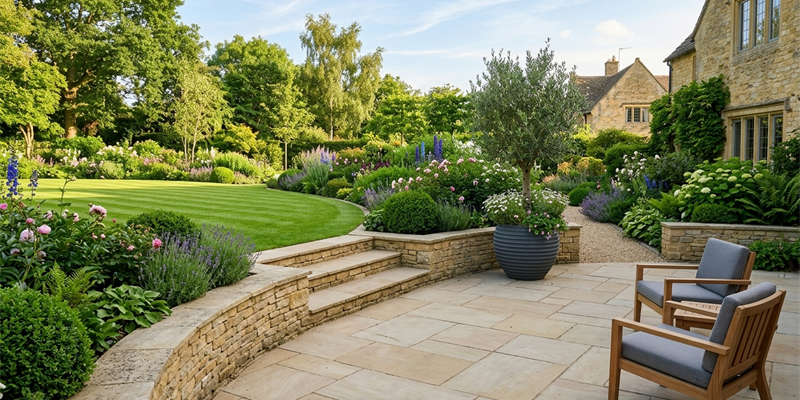
What's included
- Initial site visit and project discussion
- Patios, paths, steps and retaining features
- New lawns and lawn reshaping
- Garden beds and raised planting areas
- Planting plans suited to the site
- Levels, drainage, access, materials and waste planning
A successful Toronto garden needs more than attractive paving and plants. It has to cope with heavy rain, snowmelt, freezing temperatures and repeated freeze-thaw cycles, while still being comfortable and practical during the growing season.
That means we start with the site itself: where water moves, how the levels work, what is already worth keeping, where sun and shade fall, and how people need to move through and use the space. The visible finishes come after those decisions, not before them.
How a landscaping project works
- Site visit — review the space, take key measurements and discuss how you want to use the garden.
- Design and quote — define the layout, scope, principal materials, planting direction and any existing elements that should remain.
- Ground preparation — deal with drainage, levels, excavation and suitable bases before installing finished surfaces.
- Construction — complete retaining work, steps, paving, paths, lawn areas and planting in a sensible sequence.
- Handover — leave the site tidy and provide practical guidance for establishing new lawn, planting and other garden elements.
Drainage and snowmelt come first
A garden can perform well during summer and still reveal serious problems when snow melts or prolonged rain arrives. Low spots, poorly graded paving and compacted ground can leave water collecting beside paths, patios, lawns or buildings.
For that reason, drainage and levels are considered before new paving or planting goes in. The aim is to move water sensibly through the site without simply shifting the problem from one part of the garden to another.
Planting areas matter too. A bed that remains saturated after thaw or heavy rain may need a different solution from one that dries quickly in midsummer.
Build for freeze-thaw conditions
Patios, paths and steps in Toronto have to deal with repeated freezing and thawing. Good-looking surface material cannot compensate for an inadequate base underneath it.
Preparation therefore matters: excavation depth, compacted base material, drainage, edge restraint and finished falls all need to suit the particular feature and site conditions. Taking shortcuts below the surface can lead to movement, settlement or water problems later.
Material choice should also reflect how the area will be used, how exposed it is and how it will be maintained through winter.
Planting for Toronto conditions
Planting should work with the garden rather than against it. We consider sunlight, soil, drainage, exposure, available root space and mature plant size, along with whether the selected plants are suitable for local winter conditions.
Conditions can also vary sharply within a single property. An exposed front garden may behave very differently from a sheltered backyard, while planting beneath mature trees may have to cope with both shade and strong root competition.
Where healthy existing trees and shrubs are already doing well, we would normally look for ways to retain them and build the new design around them rather than replacing them without a practical reason.
Not every garden needs a complete rebuild
A landscaping project does not have to mean removing everything and starting again. Existing trees, shrubs, walls, paths or other features can often remain if they are sound and still work with the new layout.
Sometimes the most useful improvement is much smaller: correcting one drainage problem, rebuilding an uncomfortable patio, simplifying a difficult lawn edge or redesigning a planting bed that has never performed well.
Larger projects can also be phased so that the technically important work is completed first and other areas are improved later as budget and priorities allow.
Small projects are welcome too
A single patio, path, entrance area, front garden, lawn or troublesome planting bed can be a worthwhile project in its own right. We would rather define the work that genuinely improves the space than turn every enquiry into a complete garden reconstruction.
Request a free quote → — tell us which part of the garden you want to improve, what is not working now and, if useful, include a few photographs of the site.
Frequently asked questions
Do you provide both design and construction?
Yes. A project can cover the layout, materials, levels, drainage and planting plan as well as the agreed construction work, so practical site conditions are considered from the beginning.
Why is freeze-thaw important for patios and paths?
Water in the ground can freeze and expand, then thaw again repeatedly. Proper excavation, base preparation, drainage and material installation help reduce the risk of movement and settlement.
Do I need to redesign the entire garden?
No. Many projects focus on one problem area such as a patio, path, lawn, planting bed or drainage issue. Larger gardens can also be improved in phases.
Can existing trees, shrubs or hard landscaping stay?
Yes. If existing features are healthy, structurally sound and useful within the new layout, retaining them is often more sensible than replacing them.
Do you take winter conditions into account when choosing plants?
Yes. Plant selection should consider winter hardiness as well as light, soil, drainage, exposure, available space and the amount of maintenance the planting will realistically receive.
Can a larger project be completed in stages?
Yes. Drainage, levels, access and other work that would be difficult to change later can be completed first, with planting or secondary areas added in later stages.